The Platform Timer Is Not Your Work Record
Why AI raters need an independent log when time reports are delayed, unclear, or disputed
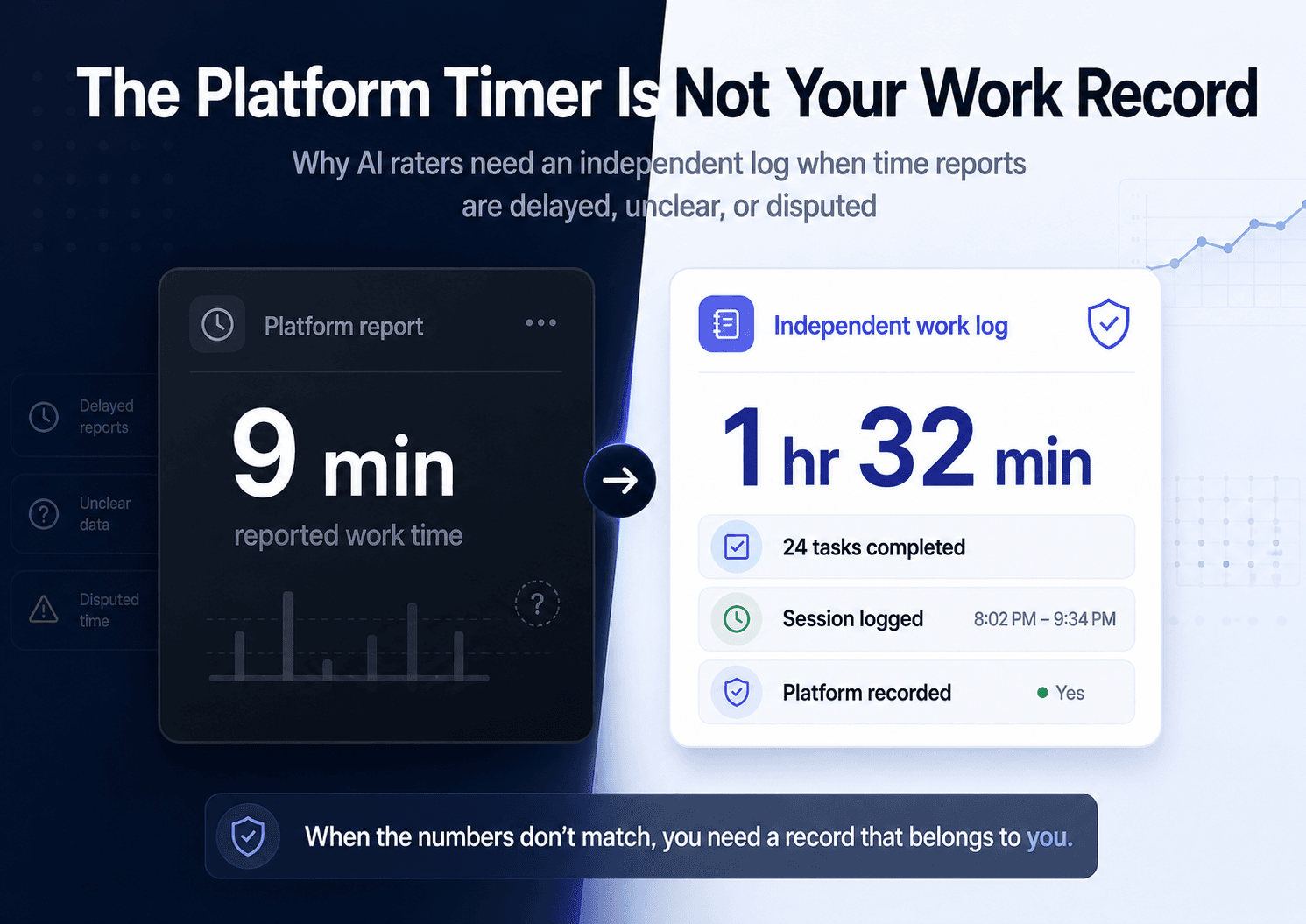
You finish a session. You know you were active — watched the videos, reviewed the tasks, typed the responses, submitted the work.
Then the platform report says you worked nine minutes.
Now what? Memory? A screenshot? A browser timer? A Discord thread full of other people reporting the same thing?
This is one of the uncomfortable realities of AI rating work: the platform timer is not the same thing as your own work record. And when the numbers don't match, that gap matters.
The platform report isn't always the full story
Most AI rating platforms give workers some kind of time or task report — submitted hours, task counts, production time, payable time, idle time, some internal version of activity. The problem is that workers don't control how those numbers are calculated.
A platform may deduct idle time. An extension may misread activity. A report may update late. A session may show one number while the final report shows another. Rules around what counts as payable work may not be fully transparent.
Sometimes the platform is right. Sometimes there's a genuine reporting issue. Either way, the practical problem from the worker's side is the same:
You need your own record before there's a disagreement.
Once the report looks wrong, reconstructing the session from memory is much harder than having captured it as it happened.
Why this hits AI raters specifically
In a typical hourly job, the question is simple: how many hours did I work?
Task-based AI work needs more. How long was the session? How many tasks? On which platform, on which project? Did the reported time match the actual session? Was the project worth it? Is your effective hourly rate going up or down?
A generic timer can tell you that you worked two hours. It can't tell you whether those two hours produced 12 tasks or 90, whether the platform later reported the same time, or how this session compared to the same project last week.
That's why AI raters often end up cobbling together their own systems — screenshots, notebooks, spreadsheets, phone timers, browser timers, Discord notes, calendar entries, memory. These workarounds are a sign that workers already know the platform report isn't always enough. But they're scattered across half a dozen places and they break down fast, especially across multiple platforms.
After a few weeks, basic questions get hard to answer: How much did I actually work this week? Which platform produced the most consistent return? What happened on the day the numbers looked wrong?
For casual AI work, maybe that doesn't matter. If you're taking AI rating seriously, it does.
The platform dashboard is the platform's record
This is the core point.
A platform dashboard is useful, but it reflects the platform's rules, calculations, delays, deductions, and definitions. It's built for the platform's workflow, not for your long-term visibility as a contractor.
That doesn't make the platform bad. It just means you shouldn't depend entirely on one side of the record.
If you're doing AI rating, evaluation, annotation, model review, or domain expert work, you're contributing real labor. You should have your own independent history of that labor — not because every platform is wrong, but because when the numbers are wrong, vague, delayed, or disputed, you need a record that belongs to you.
This becomes more pressing across multiple platforms, where each dashboard uses its own language and defines time, tasks, and idle activity differently. A private work log stops being a convenience and becomes your personal operating record.
What an independent AI work log should capture
A useful work log should help you keep track of:
- when you worked
- how long the session lasted
- which platform you worked on
- which project or task type you were doing
- how many tasks you completed, where supported
- how the work changes over time
The goal isn't to replace the platform's report. It's to have your own record beside it. So when the platform says one thing and your memory says another, you're not starting from zero — you have a session history, timestamps, task activity, context. Something that belongs to you.
RaterSidekick's view
RaterSidekick was built around a simple idea: the platform dashboard is the platform's record, and your work history should belong to you.
It's a private work log for AI contractors. It tracks sessions, platform activity, and task activity where supported, in one place. It doesn't capture task content, prompts, answers, screenshots, or keystrokes. The point isn't to spy on your work — it's to give you a clean, independent record of the work metrics that matter.
So when a platform report is delayed, unclear, or disputed, you're not relying only on memory.
What an independent log won't do
It won't force a platform to change its report. It won't guarantee that a platform accepts your numbers. It won't automatically resolve payment disputes.
What it will do is give you a clearer record of your own work — which lets you spot discrepancies sooner, understand your real productivity, compare platforms more honestly, and avoid guessing after the fact.
The bottom line
The platform timer is useful. It's not your work record.
Your work record shouldn't live only inside a platform dashboard you don't control, calculated by rules you may not fully see, on a schedule you can't verify.
You should have your own.
When the numbers match, great. When they don't, you'll be glad you kept one.
Want your own independent work log for AI rating work? Try RaterSidekick and start keeping a private record of your sessions, platforms, time, and task activity in one place.