
How to apply for AI training jobs: resume examples backed by your work record
To apply for remote AI training jobs, choose a listing you qualify for and tailor your resume to its domain, task types, quality standards, and eligibility rules. Use your real work history to support each claim. Include dates, hours, projects, and task counts you can explain. Leave out confidential details and results you never measured.
Remote AI training work goes by many names: AI trainer, AI rater, AI evaluator, data annotator, or AI contractor. These remote AI jobs are offered through platforms such as DataAnnotation, Outlier, Handshake, and Mercor. On platforms that screen resumes, such as Outlier and Mercor, your resume or profile is checked against the listing's requirements before you reach an assessment or a project.
Generic resume advice may suggest claims like "Improved AI model accuracy by 10%." Contractors rarely get the information needed to substantiate that. Describe the work you did, the guidelines you followed, and your subject expertise instead.
Your work history gives you evidence for an application. This guide includes three resume examples, a bullet formula, and steps for tailoring to a listing and checking your fit. Use the same approach for a CV or a resume.
How to apply for AI training jobs: the short version
- Pick listings you qualify for. Check the domain, task type, and eligibility requirements, such as location, language, and weekly availability, before you spend time on an application.
- Build your resume from your work record. Name the task types you've done and the standards you applied, then add scope your records support: dates, hours, task counts, and projects.
- Tailor it to each listing. Rewrite your summary, first bullets, and skills in the listing's terms, using only experience you have.
- Check your fit before you apply. Match each requirement to a line on your resume, and fix anything your resume doesn't show clearly.
- Keep your record current. Log hours and tasks as you work, so your next application starts from facts rather than memory.
What happens when you apply for AI contractor jobs?
Some platforms screen your resume against a specific listing before you reach the next step. Outlier says it reviews each resume to check whether an applicant meets the minimum requirements for specific domains, and its FAQ asks for a current resume and a LinkedIn profile that shows your education and work experience. Mercor's application fit check compares your profile and resume with each listing's requirements and category. When alignment looks low, it warns you but lets you apply. When it's judged inadequate, you can't apply to that listing, and there's no manual override.
The resume isn't the only screen. Outlier's onboarding includes assessments before you're matched to projects, and on Mercor, interviews and assessments can follow the fit check. A strong resume won't replace those steps, but it's often what gets you to them.
A listing usually screens for four things, and each one has a kind of evidence that answers it:
| The listing screens for | Example requirement | Evidence that answers it |
|---|---|---|
| Domain | "Degree in chemistry" · "Registered nurse" | Your degree, license, or years in the field, stated in your title line and summary |
| Task type | "Rate model responses" · "Write prompts" · "Review code" | Bullets that name the same task types, with counts from your records |
| Standard of work | "Excellent written English and attention to detail" | Rubric-based work with written rationales, reviewer roles, and steady volume over time |
| Eligibility | Location · language · weekly availability | Your location, work authorisation, language proficiency, and available hours |
What should an AI trainer resume include?
A screener reading your resume wants to know what kind of work you did, to what standard, with what expertise, and how much of it.
| Section | What to show | Example |
|---|---|---|
| Title | A plain description of the work, marked as contract | AI Trainer (Contract) · AI Response Evaluator · AI Trainer, Chemistry Expert |
| Summary | Your field, your AI training experience, and the task types you know best | Registered nurse with 14 months of contract AI training, evaluating clinical answers for accuracy and safety |
| Experience | Task types, the standards you applied, and scope from your records | Rubric-based evaluation, response rewriting, fact-checking, prompt writing, peer review |
| Qualifications | Degrees, licenses, professional experience, spoken languages, and programming languages | MSc Chemistry · fluent Spanish · Python |
| Skills | A short, specific list that matches the listings you want | Fact-checking · preference ranking · scientific writing |
Your subject expertise often matters more than AI vocabulary. If your degree, license, or years in the field are hard to find, a screener may miss them, so put them in your title line or summary rather than only at the bottom of the page.
What to leave out
- The client or AI lab behind a project, unless your agreement allows you to name it
- Project codenames, model names, internal guidelines, and screenshots
- Specific prompts, responses, or other task content
- Pay rates
- Results you never measured, such as improvements in model accuracy
How to prove your AI training experience with your work record
Use the record of work you've already done. Contractors rarely see what happens to a model after their tasks, so model accuracy isn't a result you can claim. Your own work is, and a record of it turns "worked on AI projects" into something a screener can picture: which task types, on which platforms, over what period, and how much.
Your records can support:
- The dates you worked on each platform or project
- Total hours, and hours per week if a listing asks about availability
- Task counts by task type
- The number of projects
- Role changes, such as becoming a reviewer
They can't support: claims that a model improved, results for the client's business, or quality scores and rankings, unless the platform gave them to you and you're allowed to share them.
Activity totals show volume. They don't establish the task type or prove its quality. Keep notes about your responsibilities and use the platform's feedback where you have it.
Here's what a record adds to a single bullet:
- Without a record: Worked on AI projects for several platforms
- With a record: Evaluated 900+ AI-generated responses for accuracy and instruction-following across five projects since March 2025, with a written rationale for every rating
Rules that keep the numbers honest
- Round down. If your records show 947 tasks, write "900+."
- Pair counts with task types. A five-minute rating and a two-hour coding task aren't the same unit, so "650 code evaluations" says more than "650 tasks."
- Give the time period. "1,100+ tasks since March 2025" can be checked. "1,100+ tasks" on its own is vague.
- If you can't explain how a number was measured, leave it out. An interviewer may ask.
Where the numbers come from
Your numbers can come from platform dashboards, payment records, your own spreadsheet, or a work log. Platform dashboards don't always keep your history, especially after a project ends or you lose access. That's why the platform timer isn't your work record.
RaterSidekick keeps your tracked activity and imported history in one place. You can add supported totals to a resume. With your permission, its fit check also reads rounded-down tracked hours and task counts by platform. Imported figures stay separate and aren't read automatically by the fit check.
Keep confidential work confidential
Handshake's guidance for fellows is a useful model. It encourages you to share your role, responsibilities, and the value of your work, but not the name of the partner company or AI lab, or any internal materials. Other platforms set their own rules in your contractor agreement, so check yours rather than assuming one platform's rules apply everywhere.
Describing the type of work ("evaluated model responses in organic chemistry") is the usual level of detail, and so are totals from your own record, such as hours, task counts, and projects. Describing specific prompts, datasets, or model behavior you saw is not.
AI trainer resume examples: generalist, specialist, and coding evaluator
These three examples cover teaching, subject research, and software engineering. Each one pairs its task types with scope from a work record, such as task counts, hours, projects, and dates. The people, dates, and numbers are made up. Use your own, and include a number only if your records support it.
Example 1: Generalist writing evaluator
A former high school English teacher who has done part-time evaluation work on two platforms since March 2025.
AI Trainer | Writing Evaluation and Editing
Summary: Former high school English teacher with 18 months of contract AI training. Evaluate and rewrite AI-generated responses for accuracy, instruction-following, and tone, with a written rationale for every rating. Comfortable moving between projects with different guidelines.
AI Trainer (Contract, part-time, remote) | DataAnnotation and Outlier | Mar 2025 to Present
- Evaluated AI-generated responses for factual accuracy, instruction-following, and clarity, documenting each rating against project rubrics
- Rewrote flawed responses to meet style, tone, and length requirements, explaining each change
- Compared paired responses and wrote rationales explaining which better answered the user's request
- Completed 1,100+ evaluation tasks across six projects since March 2025
English Teacher | [School district] | Aug 2018 to Jun 2024
- Taught writing and literature to about 150 students a year
- Built the department's shared essay-grading rubrics
Skills: Rubric-based evaluation · Editing and rewriting · Fact-checking · Written rationales · Research
Why it works
- Grouping two platforms into one entry keeps a part-time contract history from looking scattered.
- Each bullet names a task type and a standard, rather than "worked on AI."
- The scope line comes from a work record: a rounded-down task count, the number of projects, and the period it covers.
- The teaching job still earns its place: building grading rubrics is directly relevant to rubric-based evaluation.
Example 2: Subject specialist (Handshake AI Fellowship)
A molecular biology PhD candidate who does expert evaluation alongside research. The entry follows the structure of Handshake's template for fellows: a title that names the domain, contract employment, and Handshake AI Fellowship as the company, without naming the partner lab.
Molecular Biologist | AI Trainer, Biology Expert
Summary: PhD candidate in molecular biology with nine months of contract AI training. Write graduate-level biology prompts and evaluate model responses for scientific accuracy, completeness, and depth, grounded in the primary literature.
AI Trainer, Biology Expert (Contract, remote) | Handshake AI Fellowship | Jan 2026 to Present
- Wrote graduate-level prompts in genetics and cell biology designed to expose reasoning errors in large language model (LLM) responses
- Evaluated model answers for scientific accuracy and depth, citing primary literature in written rationales
- Researched adjacent subfields to verify claims beyond core specialty
- Logged 240+ hours across four projects
Graduate Researcher | Department of Molecular Biology, [University] | Sep 2022 to Present
- Designed and ran CRISPR knockout screens; co-author on two peer-reviewed papers
Education: PhD candidate, Molecular Biology, [University], expected 2027 · BSc Biochemistry
Skills: Molecular biology · Genetics · Experimental design · Literature review · Scientific writing · Prompt writing · Rubric-based evaluation
Why it works
- Subject expertise leads. For specialist work, the degree and research are the qualification; the AI training shows you can apply them to model evaluation.
- Hours describe expert work better than task counts, because a single expert task can take an hour or more.
- It describes the type of work without naming the lab or the project, in line with Handshake's guidance.
- The research and publications stay on the page because they're the evidence behind "expert."
Example 3: Coding evaluator
A backend engineer with six years of industry experience who has done contract code evaluation since leaving a full-time role.
Software Engineer | AI Code Evaluation
Summary: Backend engineer with six years of Python and TypeScript experience and 18 months of contract AI training. Evaluate model-generated code for correctness, efficiency, and readability, and write tests to verify outputs and pinpoint failures.
AI Code Evaluator (Contract, remote) | Mercor | Mar 2025 to Present
- Evaluated AI-generated Python and TypeScript solutions for correctness, edge-case handling, efficiency, and readability against project rubrics
- Wrote and ran unit tests to verify model outputs, documenting each failure with a reproducible example
- Ranked paired code responses and wrote rationales explaining the preferred solution
- Completed 650+ code evaluations across three projects
Backend Software Engineer | [Company] | Mar 2019 to Feb 2025
- Built and maintained Python payment APIs handling over 2 million requests a month
Skills: Python · TypeScript · SQL · Unit testing (pytest, Jest) · Code review · Algorithm analysis · Rubric-based evaluation
Why it works
- It reads like a code reviewer's resume, which is what coding evaluation is.
- Writing and running unit tests is stronger evidence than "checked code."
- The task count comes with its task type, so a reader can judge what the number means.
How to turn AI evaluation work into resume bullets
Use this formula: what you did + what you worked on + the standard you applied + scope from your records (optional).
For example: Evaluated + AI-generated chemistry answers + for accuracy and completeness against project rubrics + across 400+ tasks.
Weak bullets usually leave out one of those parts. Here's how to fix the most common ones:
| Too vague | More informative, where accurate |
|---|---|
| Worked on AI tasks for several companies | Evaluated AI-generated responses for factual accuracy, instruction-following, and clarity, documenting each decision against project rubrics |
| Rated chatbot answers | Compared paired model responses and wrote rationales explaining which better met the user's request |
| Did fact-checking | Verified claims in model responses against reliable sources and flagged unsupported or outdated statements |
| Labeled data | Annotated text and images using detailed labeling guidelines, escalating ambiguous cases for review |
| Wrote prompts | Wrote challenging [your field] prompts designed to expose gaps in model reasoning |
| Checked other people's work | Reviewed peer submissions for guideline compliance and gave contributors written feedback |
Once a bullet describes the work, you can add scope from your records, either at the end of a bullet or as its own line:
Completed [task count from your records] evaluations across [number] projects, including response comparison and factual review.
Need a one-line AI trainer job description for your resume, LinkedIn, or an application form? Adapt this:
Contract AI trainer evaluating, comparing, and rewriting AI model outputs against detailed quality guidelines.
How to write an AI trainer resume summary
Keep it to two or three sentences: your field or strongest credential, how long you've done AI training, the task types you know best, and one thing that sets you apart. All three examples above follow that pattern. Rewrite the summary for each application, because it's the first thing a screener reads.
Skills to list on an AI trainer resume
List the skills you can back up with a bullet:
- Evaluation: rubric-based evaluation, preference ranking, fact-checking, response rewriting, prompt writing, written rationales, quality review
- Expertise: your field (for example, clinical nursing, contract law, or organic chemistry), languages, and programming languages
- Working style: interpreting detailed guidelines, staying consistent across long task sets, independent research
Terms like "RLHF" (reinforcement learning from human feedback) and "LLM evaluation" can help your resume match a listing, but use them only where they describe what you did. Ranking model responses by preference is one part of how RLHF data is collected. It isn't the same as training models yourself.
How to list work across multiple AI platforms
You have two options: a separate entry for each platform, or one grouped entry.
Use separate entries when each platform involved substantial or different work, when you held a distinct role on one of them (such as reviewer), or when the listing you're applying for values one platform's type of work.
Use one grouped entry when you've had several short or overlapping contracts doing similar work. One "AI Trainer (Contract)" entry that names the platforms, as in Example 1, reads better than five three-month entries.
Totals from your work record make the choice easier, because they show which platforms and projects were substantial enough to stand on their own. Either way:
- Give dates as month and year, and label the work as contract or part-time if it was.
- Use "Present" only if you're still doing the work, not just holding an account.
- Keep titles and dates consistent with your LinkedIn profile.
- If there were long gaps between projects, don't imply continuous work. "Project-based" in the title line sets the right expectation.
Generalist projects between specialist roles still belong on your resume, because they show recent, relevant work. For more on that pattern, see how AI raters can turn project work into a more consistent income stream.
How to tailor your resume to an AI training job description
Screening is about fit with a specific listing, so one generic resume undersells you. Tailoring doesn't mean adding experience. It means making the relevant parts of your real experience easy to find.
- Find what the listing screens for. Usually four things: a domain ("degree in chemistry"), a task type ("rate responses," "write prompts," "review code"), a standard of work ("excellent written English"), and eligibility (location, language, availability).
- Match each requirement to evidence you already have. If the evidence exists but is buried or phrased differently, rewrite it plainly in the listing's terms. Your work record often holds evidence your resume leaves out, such as a task type you've done hundreds of times but never listed.
- Lead with the closest match. Rewrite your summary for this listing and move the most relevant bullets to the top.
- Cut what doesn't help this application, especially if it pushes the relevant parts down the page.
- Don't add what you don't have. If the listing requires a license, degree, or location you don't have, rewording won't change that.
One contractor, two listings
Take a contractor with an MSc in chemistry, six years of teaching the subject, and a year of AI training that mixed writing evaluation with chemistry tasks. Nothing is invented for either version. Only the emphasis changes.
| Resume section | AI writing evaluator listing | Chemistry expert listing |
|---|---|---|
| Title line | AI Trainer, Writing Evaluation | AI Trainer, Chemistry Expert |
| Summary opens with | "Writing evaluator and former teacher who applies detailed rubrics…" | "MSc chemist and former chemistry teacher who evaluates…" |
| First bullet | Rewrote AI responses to meet style, tone, and length guidelines | Solved and verified graduate-level chemistry problems to check model reasoning |
| Moves down the page | Chemistry-specific bullets | General editing bullets |
| Skills listed first | Editing, rubric-based evaluation, written rationales | Organic chemistry, problem verification, scientific fact-checking |
How to check your resume against a listing before you apply
The last step before you apply is a fit check: take each requirement in the listing and find the line on your resume that shows it. A requirement with no matching line is either a gap you can close with evidence you already have or one you can't. Only the first kind is worth editing for.
You can do this by hand with the listing and a highlighter. RaterSidekick does the same comparison with your work record included.
What a fit check backed by your Work Log looks like
RaterSidekick compares the text in your selected resume with a pasted listing. You can include tracked activity totals and your stated location or work authorisation. The result separates what your resume already shows, what editing could clarify, and qualifications that editing can't add.
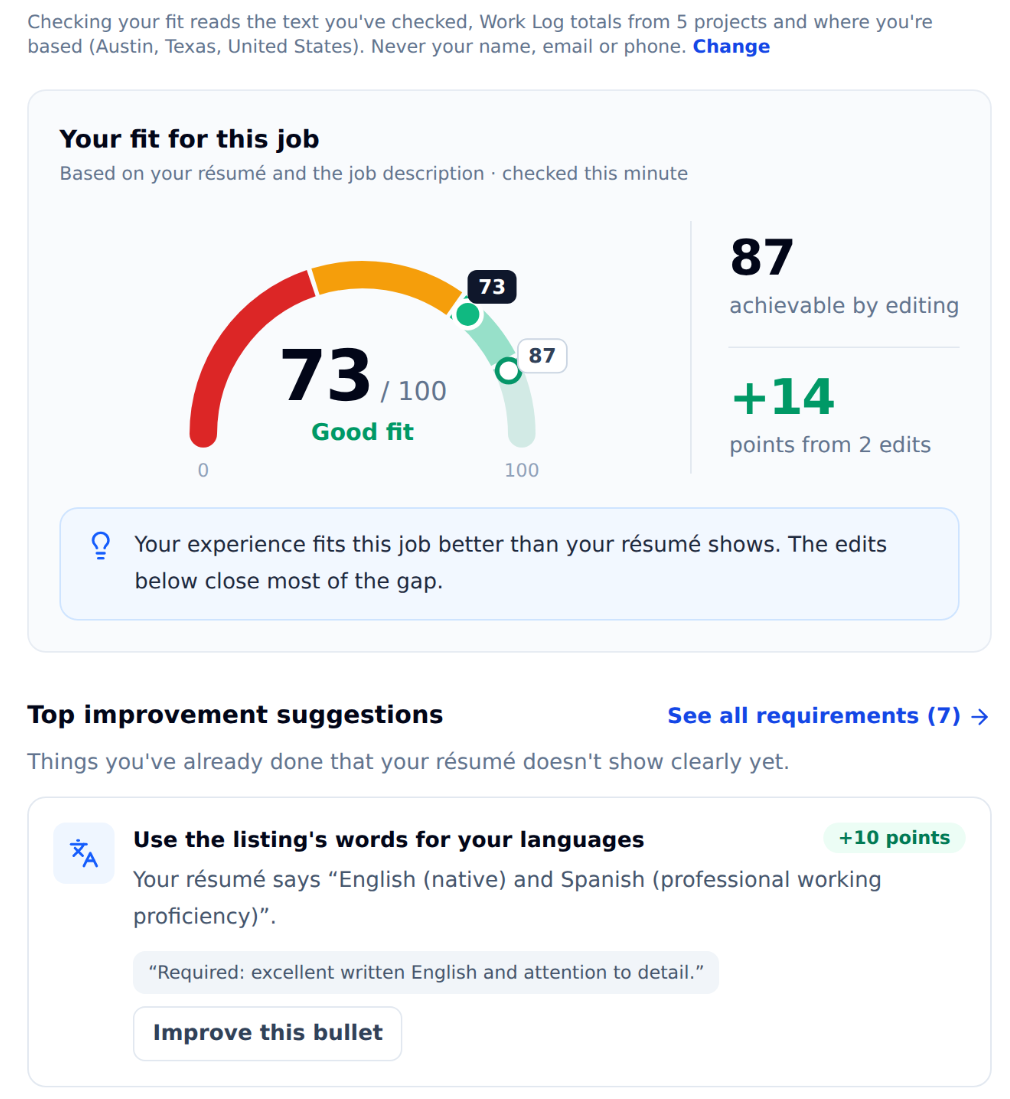
The fit check shown here scores a resume at 73/100, with 87 projected by editing and tracked totals from five projects included.
In this example:
- What it reads. The text in your selected resume, optional tracked totals from your projects, and your stated location or work authorisation. The dedicated name, email, and phone fields are excluded. Project names and pay aren't included in the activity totals. The current fit check reads uploaded text without requiring each section to be confirmed first.
- Where you are and where you could be. This resume scores 73 out of 100, a good fit, and the check puts 87 within reach by editing. Two edits account for the 14-point difference.
- Why there's a gap. The check sums it up: "Your experience fits this job better than your résumé shows." The suggestions are things you've already done that your resume doesn't show clearly yet, so closing the gap means presenting your experience better, not adding to it.
- The evidence side by side. Each suggestion shows what your resume says now, the listing requirement it relates to, and how many points the edit is worth. "See all requirements" lists the requirements the check identified, seven in this case.
The top suggestion here is worth 10 points. The listing requires "excellent written English and attention to detail." The resume says "English (native) and Spanish (professional working proficiency)." The suggestion asks for clearer evidence of written English. If that proficiency is accurate, an edit could use the listing's terms:
Languages: English (native, excellent written English) · Spanish (professional working proficiency)
Your work record supports the rest of the requirement. "Attention to detail" is only a claim on its own, but a bullet like "Wrote a rationale for every rating across 900+ rubric-based evaluations since March 2025" is evidence of it.
How to check your fit and tailor your resume in RaterSidekick
- Paste a job listing. RaterSidekick picks the resume that's closest to it, and you can choose a different one. No resume yet? Upload your CV or start from scratch. Check the extracted text for mistakes. A fit check can read it immediately; you don't have to confirm each section first.
- Check your fit. "Check my fit" shows your score, the score you could reach by editing, the top suggestions, and the requirements the check identified. Nothing on your resume changes.
- Make a tailored copy. "Make tailored copy" creates a version for that listing and suggests how to present your relevant experience in its terms. Your original stays as it is.
- Keep what's accurate, then download. You choose which suggestions stay.
Tracked activity and imported reports can support numbers you add to your resume. The fit check's optional activity input uses tracked totals only, rounded down by platform and month range. It doesn't include imported history, project names, or pay. You don't need the extension or tracked history to check or tailor a resume. If you'd like to start a record, see time tracking for AI raters.
The fit score describes evidence in your resume for one listing. The achievable score estimates what editing your existing experience could clarify; it isn't a promised result. A required qualification that editing can't add keeps that score low. This is neither an official platform or ATS score nor a hiring prediction. Platform screening and assessments still apply.
Common questions about applying for AI training jobs
How do I apply for AI training jobs with no AI training experience?
Lead with the expertise the listing asks for. For specialist work, your degree, license, or professional experience is the main qualification, and platforms such as Outlier screen resumes for domain requirements. Describe related work in plain terms, such as grading against rubrics, editing, code review, or fact-checking, but don't claim AI training experience you don't have. Once you've completed your first projects, keep a record so your next resume can show them.
What do AI training platforms look for in a resume?
Evidence that you fit a specific listing: the domain expertise it asks for, the task types you've done, the standard you work to, and eligibility such as location and language. Outlier reviews each resume against minimum domain requirements, and Mercor's fit check compares your profile and resume with a listing before you can apply. A resume that states these plainly, with scope from your records, is easier to match.
Can I put DataAnnotation, Outlier, Handshake, or Mercor work on my resume?
Check your agreement before naming a platform, partner, or project. Handshake's public guidance permits naming the Handshake AI Fellowship and describing your responsibilities, but excludes partner labs and internal materials. Other platforms can set different limits. Ask the platform if your agreement is unclear.
Can I list my hours and task counts on my resume?
Use totals your records support when your agreement permits sharing them. Be ready to explain how you measured them. Round down, pair each count with its task type, and give the period it covers, as in "650+ code evaluations since March 2025." Leave out pay rates, quality scores you aren't allowed to share, and any claim that a model improved.
What if my platform dashboard no longer shows my work history?
Rebuild what you can from payment records and your own notes, and use conservative, rounded-down numbers you can explain. Dates and project counts are usually easier to reconstruct than task counts. From now on, keep your own work log, so your next resume doesn't depend on a dashboard that may not keep your history.
What job title should I use for AI training work?
Use a plain title that describes the work: AI Trainer, AI Response Evaluator, AI Code Evaluator, Data Annotator, or AI Trainer, [Your Field] Expert. If the platform gave you a clear title, use it. Mark the work as contract, and don't upgrade the title to one that implies a different job, such as AI Engineer.
Do I need a different resume for each AI training listing?
You need a different emphasis, not different facts. Rewrite your summary, reorder your bullets, and lead your skills with the listing's terms, so the relevant parts of your real experience are the first things a screener sees. Keeping one full resume and making a tailored copy for each listing is faster than starting over.
Does AI training work count as real experience?
Yes. It's paid contract work involving evaluation, writing, research, and subject-matter judgment. Present it like any other contract role, with a title, dates, responsibilities, and scope. The same skills carry over to roles outside AI, such as quality assurance, editing, research, and content review.
Where should AI contract work go if I also have a full-time job?
If AI training is a side contract, keep your main career first and add one grouped entry for the contract work. When you apply for AI training roles, move that entry up so it's one of the first things a reader sees.
Check your next application
Paste a listing, check your fit, and review a tailored copy before you apply. Add your tracked totals if you want the check to consider them. Try for free. Seven days, no card required.
RaterSidekick is independent and is not affiliated with or endorsed by DataAnnotation, Outlier, Handshake, or Mercor. Platform guidance referenced in this article was checked on September 30, 2026.